
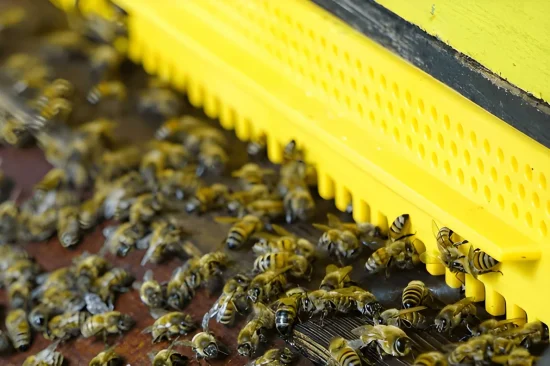
A cluster of bees entering a gap beneath the roofline sparks a common question: where is the queen, and is she dangerous? The concern is understandable, but it points attention in the wrong direction. A queen is essential to a colony, yet she almost never appears at an entrance, and the insects that building occupants meet are workers. For owners and managers, colony behavior and the building’s openings matter far more than any single bee.
The Queen’s Role Inside the Colony
A honey bee colony has one queen, and her job is reproduction. She lays eggs, often many hundreds in a day during peak season, and releases chemical signals called pheromones that help keep the colony organized. Workers feed and groom her, tend the brood, build comb, and defend the nest.
She rarely leaves. A queen usually flies only twice in her life: on mating flights early on, and when a colony swarms to found a new nest. The rest of the time she stays deep inside the cluster, surrounded by attendants. A property manager is unlikely ever to see her.
Colonies also replace queens. If one dies or weakens, workers raise a new queen from a young larva. That resilience means removing or killing a single bee does not end a colony. The entire group, along with its comb and stored honey, determines whether a nest persists.
Why Workers Are the Bees People Encounter
Workers make up nearly all of the insects at an entrance. They are female, they forage for nectar, pollen, and water, and they guard the nest. When a building owner sees bees streaming in and out of a wall, soffit, or chimney, the traffic is workers on foraging trips or defending the opening.
Defensive behavior also comes from workers. Honey bees guarding a nest may sting if they perceive a threat, particularly when vibration, noise, or heavy disturbance reaches the colony. The question “do queen bees sting” often arises because the queen is rarely seen and little discussed. The answer is that she can sting but seldom does, mostly using her stinger against rival queens inside the hive. Her presence is not a hazard to occupants, and a worker is far more likely to be responsible for any encounter.
Understanding who is who prevents misplaced effort. Searching for a queen on a wall or trying to remove one bee does nothing. Managing access, safety, and the nest itself does.
Why Colony Behavior Matters More Than a Single Insect
Colonies grow, store food, and defend territory. A small swarm that settles in a cavity in spring can build comb quickly, and a well-established colony may hold tens of thousands of bees by summer. Honey and wax add weight and moisture to the wall, and abandoned comb can attract rodents, ants, and other insects long after the bees leave.
Seasonality shapes activity. Swarms often appear in spring, when colonies divide and a portion leaves with a queen to find a new home. Scouts check potential cavities for days before the group arrives. Foraging traffic peaks on warm, sunny days, and defensive behavior increases when the colony is large or stressed.
Safety planning should focus on the group. Occupants should avoid blocking entrances, hitting the structure, or spraying the nest, which can provoke defense. Pets and children should stay away from the area. Anyone with a known allergy to stings should take extra care and keep emergency medication on hand as advised by a physician. For owners, the question is how to identify, access, and safely remove the colony, ideally with a licensed professional or an experienced beekeeper who handles live removal.
Architectural Gaps and Cavities Where Bees Establish Colonies
Bees choose cavities that offer shelter, dryness, and a small entrance. Buildings supply plenty. Wall voids, soffits, eaves, chimneys, attic spaces, roof intersections, utility boxes, and hollow porch columns all qualify. An opening roughly the size of a finger or less is often enough.
Common entry points include gaps where fascia meets the wall, torn or missing vent screens, cracks in stucco, loose flashing at roof-wall junctions, and openings around pipes and conduits. Old, unused chimneys and open meter boxes also attract swarms.
Inspection helps. Owners and managers should look at the building once or twice a year, particularly before spring, scanning rooflines and walls for gaps and for bees entering or leaving. A pattern of steady traffic at one spot suggests an established nest. A faint hum inside a wall, warm patches on the surface, or dark staining from honey and wax can indicate a hidden colony.
Design can reduce risk. Screening vents with fine mesh, sealing cracks, installing tight-fitting caps, and maintaining flashing leave fewer openings. Sealing must wait until any existing colony has been removed, because trapping bees inside leads them to chew through drywall or find a path into occupied rooms.
What to Do When a Colony Appears
A deliberate response protects occupants and the structure:
- Keep people and pets away from the entrance.
- Observe from a distance to note where the bees enter and how heavy the traffic is.
- Avoid sealing, spraying, or blocking the opening.
- Call a licensed pest professional or a local beekeeper who performs live removal.
- Plan for full cleanup, including removal of comb and honey, once the bees are gone.
- Seal and screen the opening afterward to prevent a new swarm.
Comb removal is a step many owners skip, and it matters. Leftover honey can ferment, leak through walls, and draw ants, wax moths, and rodents, while the scent of old comb attracts new swarms. Written work orders help document what was done for tenants, insurers, and future maintenance.
Final Analysis
The queen is vital to a colony yet nearly irrelevant to building management. Workers account for almost every encounter, and the colony, its comb, and the openings that admit it decide the outcome. Understanding that the queen can sting but rarely does clears away a common misconception. Regular inspections, sealed gaps, careful responses to swarms, and professional removal protect occupants and the structure alike.Read more at https://kdarchitects.us/.