
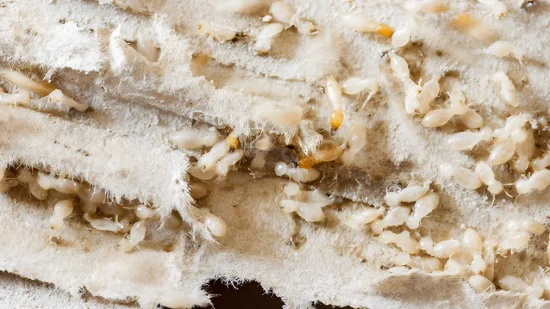
Most people picture termites in the soil. Drywood species do not need it. They live entirely within the wood they eat, drawing moisture from the timber itself and the dry air around it. A colony can start with a single pair of swarmers that find a crack in a fascia board, and it may stay out of sight for years. Southern California’s warm climate, abundant wood framing, and countless small openings in attics and eaves give these insects ideal conditions. Understanding where they hide explains why inspections can be difficult.
How Colonies Develop Without Soil Contact
Subterranean termites must stay connected to the ground for moisture. Drywood colonies do not. After a flight, a reproductive pair finds a crevice, seals themselves inside, and begins to excavate a small chamber. The colony grows slowly, often taking years to reach a size that produces visible signs.
Their waste is a clue. These wood-dwelling insects push dry, hard pellets out of tiny kick-out holes, leaving small piles that resemble coarse sand. The pellets are six-sided and uniform, and their color varies with the wood eaten. Finding them below a beam, windowsill, or baseboard suggests galleries above.
Because these colonies seldom touch the ground, treating the soil does nothing for them. Their separation from the earth also makes them harder to track, since there are no mud tubes to follow. Evidence is subtle, and the structure itself conceals much of it.
Attic Framing and Roof Structures
Attics are prime habitat. They are warm, dry, and full of untreated or lightly finished lumber, including rafters, ceiling joists, trusses, and sheathing. Insulation, ducts, and stored items block lines of sight, and low clearances make thorough inspection physically difficult.
Roof structures offer entry. Gaps beneath roof tiles, around vents, at ridge caps, and along the fascia let swarmers settle. Once inside, they can spread through connected framing for years. Damage may reach structural members before any sign appears below.
This is one reason drywood termites are a persistent concern for Southern California building owners. A technician inspecting an attic looks for pellets on insulation, kick-out holes in beams, blistered or hollow wood, and shed wings near vents. Owners can help by keeping access clear, storing items away from the hatch, and noting any pellet piles seen during routine visits. A flashlight scan from the opening, without disturbing insulation, can reveal obvious signs.
Eaves, Fascia, Window Trim, and Exposed Wood
Exterior wood is more accessible but still easy to overlook. Eaves, fascia boards, rafter tails, window and door trim, pergolas, and decks all provide entry points. Cracks, nail holes, and unpainted edges give swarmers a place to settle.
Signs appear in small details. Paint may bubble or ripple over galleries, pinholes may show along trim, and the wood may sound papery when tapped. Pellets collecting on a windowsill or in a spider web beneath the eave are a frequent giveaway.
Maintenance affects vulnerability. Sealing cracks, keeping paint intact, and replacing damaged trim reduce the number of places a colony can start. Wood that is painted and sealed on all sides is less inviting than bare or weathered lumber. Design choices play a role too. Exposed rafter tails, decorative beams, and wood trim in sheltered corners are attractive to swarmers, so protective finishes and periodic checks matter. Screens on vents prevent reproductive insects from entering attic spaces directly.
Inaccessible Wood and the Challenge of Inspection
Many buildings contain wood that nobody can see. Wall cavities, built-in cabinets, finished soffits, subfloor framing under tile, and enclosed beams conceal framing from view. Even careful inspectors cannot open every wall, so they rely on probing, listening, moisture readings, and sometimes thermal or borescope tools.
Connecting building design with inspection challenges shows how architecture can help or hinder detection. Access hatches in attics and soffits, removable panels in utility chases, and clear space around the roofline all make inspection easier. Finished spaces without access, such as sealed soffits or built-in furniture against exterior walls, hide problems.
A thorough inspector will report which areas were inaccessible and may recommend further evaluation. Homeowners should read those notes carefully. Visible clues, such as new pellet piles after cleaning, indicate ongoing activity even when the source is hidden. Treatment options vary, and a licensed professional can explain whether localized or whole-structure methods suit the situation.
Practical Steps for Owners
Owners can reduce risk and improve detection with a routine:
- Inspect attics, eaves, and trim once or twice a year with a flashlight.
- Photograph and date any pellets, wings, or damaged wood before cleaning.
- Seal cracks and keep exterior wood painted or sealed.
- Screen vents and repair roof gaps.
- Keep attic access clear and avoid blocking inspection routes.
- Schedule professional inspections, especially before buying or selling.
Avoid sealing or painting over suspect holes, which hides evidence. Do not spray store-bought insecticide on pellets or trim, since it rarely reaches the colony and can complicate later treatment. Written inspection reports help with sales, refinancing, and insurance, and they create a baseline for comparison.
Final Analysis
Drywood colonies succeed because they stay hidden. They live inside attic framing, eaves, trim, and enclosed structural wood, and they leave only small clues. Buildings that provide inspection access, maintain protective finishes, and close entry points make detection easier and infestation less likely. Owners who document what they find, resist the urge to cover or spray it, and use professional inspections turn a hidden problem into a manageable one.Read more at https://kdarchitects.us/.