
A backyard patio can add useful outdoor living space, improve property value, and make your garden more functional. However, a long-lasting patio depends on more than just pouring concrete. The real strength comes from proper ground preparation, stable base construction, correct concrete placement, and careful curing.
Plan the Patio Area
Before starting work, decide the size, shape, and purpose of your patio. A small seating area, outdoor dining space, or barbecue zone may require different dimensions. Mark the patio outline with stakes and string, then check that the layout fits your yard and allows enough room for furniture, walking space, and drainage.
Also consider the slope. A patio should not be perfectly flat. It needs a slight slope away from the house so rainwater can drain properly. A common recommendation is about 1/8 to 1/4 inch of slope per foot.
Remove Grass and Topsoil
After marking the area, remove grass, roots, soft soil, and organic material. These materials can decompose or compress over time, causing the patio to settle. Excavate according to the planned gravel base and concrete slab thickness.
For many backyard patios, a compacted gravel base of 4 inches and a concrete slab of about 4 inches are commonly used. In areas with weak soil or freeze-thaw conditions, a deeper base may be needed.
Prepare and Compact the Subgrade
The subgrade is the natural soil beneath the patio. It must be firm and stable before adding gravel. Remove soft spots and fill low areas with suitable material. If the soil is too loose, wet, or uneven, the concrete surface may crack later.
Compaction is very important at this stage. For larger backyard projects, a mini road roller can help create a more stable and even base before the next layers are added. Good compaction helps prevent sinking and keeps the patio stable for longer.
Add a Gravel Base
Lay crushed stone or gravel evenly over the prepared ground. Avoid using rounded stones because they do not lock together as well as angular gravel. The base should be spread in layers and compacted carefully.
A strong gravel base helps distribute weight, improves drainage, and reduces soil movement under the concrete. Check the height and slope as you work. Uneven gravel thickness can lead to weak points in the finished patio.
Install Formwork
Forms keep wet concrete contained and help shape the patio edges. Wood boards are commonly used for backyard patios. Set the boards along the marked edges and secure them with stakes. Make sure the form height matches the planned slab thickness.
Check that the forms are straight, level across the width, and sloped in the correct direction. Weak formwork may cause uneven edges, poor drainage, and an irregular patio shape.
Add Reinforcement if Needed
Concrete is strong under compression but can crack under tension or movement. Reinforcement can help control cracking and improve slab strength. Depending on the patio size and local conditions, you may use wire mesh or rebar.
Position reinforcement at mid-slab height instead of laying it on the ground. It should be lifted slightly with supports so it stays inside the concrete during pouring.
Mix and Pour the Concrete
For small patios, concrete may be mixed on-site with a portable concrete mixer, while larger projects may require ready-mix delivery. The mix should have the right consistency: wet enough to place and level, but not so watery that strength is reduced.
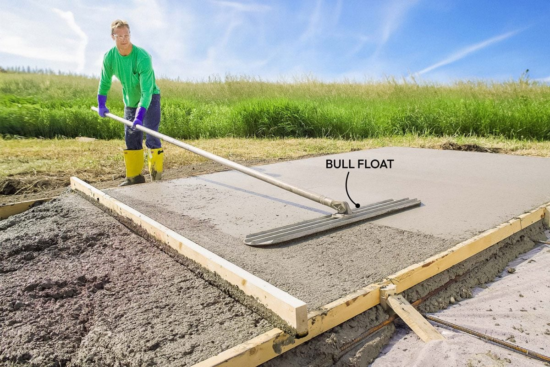
Place concrete evenly inside the forms, spread it with tools, then level the surface with a screed to remove extra material and fill low areas.
Finish the Surface
After leveling, smooth the surface with a float to settle aggregates. Avoid excessive finishing, which can draw water and cement paste upward.
For outdoor patios, a broom finish is often a good choice because it provides slip resistance. Lightly broom the surface after the concrete stiffens enough to keep the texture.
Cut Control Joints
Concrete naturally expands, shrinks, and moves slightly with temperature and moisture changes. Control joints help guide cracks in a planned direction. They can be cut with a grooving tool while the concrete is still fresh or saw-cut after it hardens.
For best results, joints should be spaced properly and cut to the right depth. This helps reduce random cracking across the patio surface.
Cure the Concrete Properly
Proper curing keeps concrete moist, helping the patio gain strength and last longer. If it dries too quickly, the surface may become weak, dusty, or more likely to crack.
Keep the patio damp for several days by covering it with plastic sheeting or lightly misting it with water. Avoid heavy use during the early curing period. With proper preparation, pouring, finishing, and curing, your backyard patio can stay strong, attractive, and functional for many years.