
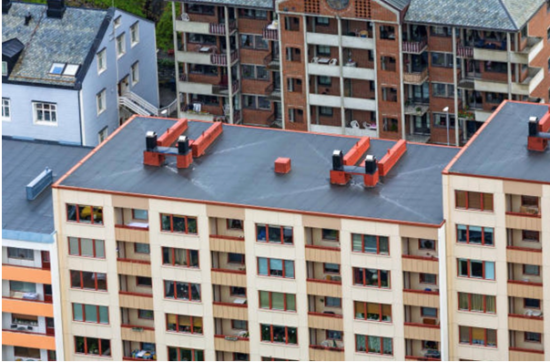
In the world of architecture and houses, the argument still goes around and around and around, and for good reason: A persistent, decades-deep narrative persists that flat roofs are an inherently flawed design and that they will inevitably get stuck with that standing water and be a maintenance hassle that will inevitably fail. This story is fundamentally about the use of low-quality, low-specification materials to construct buildings during the post-war boom, and is perhaps the most widespread disinformation in modern construction. However, the rise of modern design principles has helped reshape perceptions of flat roofing systems, emphasizing clean architectural lines, functionality, and sustainable performance. Building Science and high-performance material science of today have not only overcome the vulnerabilities of yesterday, but have transformed the flat roof into a platform for energy performance, space innovation, and environmental resilience.
The breakthrough in the technical revolution is the outmoded “poured” asphalt and the first generation of single-ply membranes prone to degradation by UV and heat. Modern high performance systems are engineered composite. Cold-applied liquid waterproofing systems, including those made from polyurethane methyl methacrylate (PMMA) or glass-reinforced polyester, form a single, fully adhered and seam-free roofing membrane, removing the most common failure point of existing roofs: seams. Advanced reinforced bituminous multi-layer torch-on systems are also transformative, offering the ability to withstand the movement and bridging of the roof due to structural movement and heat, reducing the risk of roof cracking where they are joined. Such materials are not only water resistant; they are strong, elastic water shields that are capable of resisting for decades the freeze-thaw and ultra-violet conditions.
The mythical “boiling in summer, freezing in winter” flat roof has also been thoroughly debunked by the inversion build-up. An inversion system is the opposite of the traditional warm roof design, where the insulation is placed beneath the waterproofing. In the traditional system, the waterproofing is placed over the low-density extruded polystyrene (EPS) insulation; in an inversion system, the high-density extruded polystyrene insulation is placed over the waterproofing. This genius re-sequencing guards the important waterproof layer from thermal shock, mechanical damage during maintenance, and the sun’s ultraviolet attack, essentially creating a thermally stable environment for the waterproof layer. These innovations have also influenced modern Roof Renovation projects, allowing property owners to upgrade aging flat roofs with advanced systems that significantly improve durability, energy efficiency, and long-term performance. When the performance specification of a current-generation flat roof, incorporating tapered drainage schemes, is combined with a modern drainage calculation that avoids standing water, the performance of the flat roof often surpasses that of a pitched roof, which may be undercover and have unseen damage.
The flat roof is no longer a matter of aesthetics but strategy from a sustainability and spatial design point of view. The roof space is being reimagined as a 5th elevation, to be used as a biodiversity net gain. A modern reinforced membrane offers a secure root barrier for a green roof that simultaneously controls on-site stormwater attenuation, a key requirement in numerous urban planning jurisdictions, while the green roof sustains biodiversity for the urban landscape. Otherwise, a blue roof can be installed to collect rainwater, or a terrace can be built to provide amenity space on an otherwise “dead” footprint. The flat roof offers the lowest, purest line for the modernist massing for the architect without the disorienting geometry of a pitched gable.
The secret of this performance, though, is in the “who.” However, sophistication of the material requires a degree of installation literacy. These are not systems for a general builder, and involve the use of certified operatives, who are knowledgeable about vapour diffusion and intricate upstand detailing. A Bedford roof company that is called in to check on an aging flat roof is often asked to transform it, instead of patching, which is both more expensive and less effective. This new generation of systems can be installed by specialist installers like lpeliteroofing.co.uk turning a liability into an asset. The flat roof controversy has been resolved, but the design world has yet to get the message.
Related Posts
How Buried Sensors Can Support Discreet Property Security
Property security is not always about visible cameras, tall fences,…
Fire Damage Restoration: What Homeowners Should Do Immediately After a Fire
A house fire is one of the most devastating emergencies…

Home Improvement With a Purpose: Where Style Meets Strategy
Have you ever walked into a newly updated home and…