
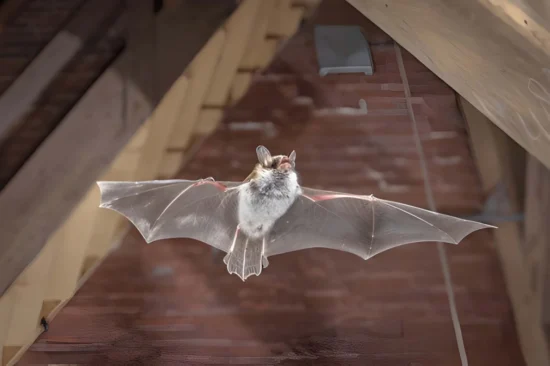
A bat needs far less room than most people imagine. A gap about the width of a pencil, tucked where a ridge cap meets the roof deck, is enough for a small colony to settle above the ceiling and stay unnoticed for months. Attics suit bats because they stay warm, dry, and out of reach of predators, much like a hollow tree or cave. The same openings that keep a roof healthy can also leave a path inside. Good design handles both needs at once. The sections below look at where bats typically get in, how to keep airflow intact, and which architectural details make a roof easier to maintain and inspect.
Why Attics Look Like Natural Roosts
Many North American bat species roost in tree cavities, rock crevices, and caves, and a modern attic reproduces those conditions closely. Sun on the shingles and heat rising from the living space keep the upper framing warm, which matters most in late spring and summer, when females gather to raise their pups. Dark corners near the ridge and gable ends hold that warmth longest, so colonies tend to cluster there.
Entry requirements are modest. Small species such as the little brown bat can squeeze through an opening of roughly three-eighths of an inch, and big brown bats need only a little more. Colonies also return to proven roost sites year after year, so one missed gap can bring the same problem back every spring.
Older homes carry extra risk, since settling and wood rot widen seams that were tight when the house was built. Design that expects this movement, rather than assuming joints will stay put, removes the opportunity before a colony ever tests it.
Ridge Vents and Soffits, Where Roofs Fail First
Ridge vents run the full length of the peak, so one weak section can open a long entry line. Many products rely on a plastic baffle or mesh insert, and years of ultraviolet exposure can leave that plastic brittle and cracked. Bats can then slip in directly beneath the ridge cap, where no one on the ground can see. Fasteners that back out and ridge caps that lift in the wind create similar gaps.
Soffits and fascia boards deserve equal attention. Open corners, loose panels, and gaps beneath dormer eaves all lead straight into the insulation. Multi-level roofs add more of these junctions, since several roof planes meet at awkward angles and each one needs flashing that stays tight.
Once a colony takes hold, damage builds quietly. Guano piles up on the insulation, urine soaks into it, and moisture lingers against the ceiling below. Discussions of bats in attic health risk usually center on histoplasmosis, a lung infection linked to a fungus that can grow in accumulated droppings, along with the dust that disturbed material releases. Closing these seams during construction or a roof replacement costs far less than a cleanup years later.
Gable Openings, Roof Gaps, and Access Points
Gable vents and louvers are often the oldest openings on a house. Wood frames shrink, slats loosen, and the screening behind them, if any, may be thin insect mesh that a bat can push through or tear. Where a louver meets the siding, a narrow gap often goes unnoticed because paint hides it.
Other entry points hide in plain sight. Roof gaps appear where a chimney meets the shingles, where a vent pipe passes through the deck, and where a porch roof joins the main wall. Flashing that has lifted or sealant that has dried out leaves a slot just wide enough for a bat. Static roof vents without internal guards add another route, and so do cable and pipe penetrations.
Attic access points can leak as well. A pull-down stair or hatch with poor weatherstripping lets conditioned air drift upward and gives bats a path into living areas if one gets past the insulation. A sealed, insulated hatch cover keeps the boundary between attic and house clear.
Keeping Air Moving While Blocking Entry
Sealing every vent is not the answer. Without steady airflow, attics trap moisture, which feeds mold, rots sheathing, and builds ice dams at the eaves in cold climates, while shingles run hotter and age faster. Building codes commonly ask for about one square foot of net free vent area per 150 square feet of attic floor, with 1:300 allowed under certain conditions, such as a balanced split between intake and exhaust. Fine mesh reduces open area, so any screening needs to be checked against that requirement.
Well-chosen hardware keeps both goals in view:
- Ridge vents: choose a product with a rigid metal baffle or screen instead of a plastic insert
- Soffits: use solid aluminum or reinforced vinyl panels, with metal mesh behind each opening
- Gable louvers: fasten hardware cloth on the interior side so the fasteners stay out of the weather
- Static roof vents: look for built-in metal guards and sealed flashing collars
Galvanized or stainless steel hardware cloth with quarter-inch openings is widely used for bat exclusion, and it resists chewing and weather far better than plastic or window screen. Anyone comparing the price of better materials with the cost of an occupied attic should factor in bats in attic health risk, moisture damage, and cleanup bills.
Roof Transitions and Inspection Access That Last
A design that works in year twenty depends on maintainability. Roof transitions such as valleys, dormer returns, and wall-to-roof joints hold up best with continuous metal flashing, overlapping laps, and fasteners placed above the water line. Exposed sealant ages quickly, so details that rely on mechanical overlap need fewer repairs. Replacing rotted fascia with rot-resistant composite stops moisture from reopening the same gap.
Inspection access matters just as much. A tight, insulated hatch in a convenient spot, a walkway across the joists, and a light inside let a homeowner check the attic without crawling over insulation. Twice a year, look for daylight at seams, droppings on insulation or below the eaves, dark rub marks near gaps, and flattened insulation. Watching the roofline for about thirty minutes after sunset in warm months can show exactly where a bat enters.
If bats are already present, do not seal anything. Bats are protected in many places, and trapping them kills them and pushes survivors deeper into the walls. Exclusion belongs outside the maternity season, using one-way devices installed by a licensed wildlife professional. Anyone bitten or scratched, or who wakes to find a bat in the room, should contact a doctor or the local health department promptly, since bats can carry rabies.
Key Takeaways
A bat-resistant attic comes from small details done well. Rigid metal screening replaces brittle plastic, flashing stays tight at every transition, and ventilation is checked against code instead of guessed. Regular looks from an accessible hatch catch new gaps early, and a licensed professional handles any colony already inside. Roofs built and maintained this way stay dry, last longer, and keep the rooms below free of guano and moisture problems.Read more at https://kdarchitects.us/.